


Algorithmic trading has accelerated crypto markets into a new era, forcing you to adapt to a data-driven structural shift where automated strategies govern liquidity and price discovery; it delivers unmatched speed and efficiency that can amplify your edge, yet carries systemic risks, opacity, and flash crashes that can magnify losses and correlated failures, so you must assess models, execution, and risk controls to navigate whether this represents the quintessence of market evolution or a perilous inflection point.
The Rise of Algorithmic Trading
As markets digitized, you’ve seen algorithmic strategies shift from niche program trading to dominant market force: by the mid-2010s high-frequency and algorithmic activity accounted for over 50% of U.S. equity volume, and in crypto bots now provide continuous liquidity and arbitrage across dozens of venues. Algorithms give you millisecond execution, automated risk controls, and global reach, yet they also introduce systemic fragility through feedback loops, flash events, and concentrated liquidity provision.
Historical Context
Tracing the arc, you’ll note program trading in the 1980s evolved into electronic order routing in the 1990s, while VWAP/TWAP algos standardized execution for institutions. The 2010 Flash Crash prompted new monitoring and market-data feeds, and after Bitcoin’s 2009 launch firms like Jump and Jane Street entered crypto by the 2010s, scaling algorithmic market-making across centralized and decentralized venues.
Technological Advancements
Latency and compute advances transformed strategy design: you can co‑locate servers at exchange matching engines, use FPGAs and GPUs for microsecond decisioning, and leverage FIX/WebSocket APIs for direct access. Machine learning models, backtesting libraries (e.g., Backtrader) and cloud orchestration let you iterate faster, while MEV and front‑running on blockchains reveal new vectors for both profit and market harm.
To be specific, interexchange latency fell from tens of milliseconds to single‑digit milliseconds via microwave/fiber links, while on‑site matching engines deliver microsecond order handling, enabling you to capture fleeting spreads. Firms deploy FPGAs for order serialization, GPUs for deep learning signals, and tools like Zipline, Catalyst or custom C++ engines for production; regulators and teams now focus on safeguarding against flash liquidity withdrawal and algorithmic cascades.
Mechanisms of Algorithmic Trading
Beneath order books and FIX streams, you witness systems that convert signals into trades with latency measured in microseconds to milliseconds and holding periods from sub-second to several days. Execution engines use smart order routing, iceberg orders and adaptive sizing to limit market impact; risk managers embed kill-switches and position limits. Backtesting relies on tick-level replay and backtesting adjustments for fees and slippage to estimate realistic P&L and drawdowns.
Types of Algorithms
You work with families like market making, statistical arbitrage, momentum, mean reversion and execution algorithms-each demands distinct latency, inventory and capital profiles. Market makers aim for tiny spread capture; arbitrage exploits cross-exchange gaps; execution algos minimize slippage on large orders. Thou be aware that operational risk, data needs and regulatory exposure vary sharply between types.
- Market Making
- Arbitrage
- Momentum
- Mean Reversion
- Smart Order Routing
| Market Making | Latency: <1ms to a few ms; profit per trade: 0.01-0.5% |
| Statistical Arbitrage | Uses cointegration pairs, lookback windows 5-120s; requires robust signal decay controls |
| Momentum | Relies on short MA crossovers (1-30min) and execution at trend onset; slippage sensitivity high |
| Cross‑Exchange Arbitrage | Latency‑sensitive, profits often 0.01-0.5%, holding time seconds to minutes |
| Execution / SOR | Splits orders using TWAP/VWAP; reduces market impact by targeting 20-40% of naive slippage |
Data Analysis and Machine Learning
You build features from L2 order books, time-and-sales, on‑chain metrics and social-sentiment feeds; common models include gradient boosting, random forests and LSTMs. Emphasize walk‑forward validation and cross‑validation to detect overfitting, and limit lookahead bias when labelling short-term targets.
Dig deeper into feature engineering: order book imbalance, quoted depth slope, recent trade aggressor ratios and on‑chain flow (net inflows to exchanges) often drive short-horizon forecasts. Deploy models with online updates or weekly retraining to handle non‑stationarity; use latency‑budgeted inference (<5ms) for execution signals and asynchronous batch scoring for research. Finally, pair ML outputs with strict stop rules and anomaly detectors to prevent catastrophic live drift.
The Impact on Market Dynamics
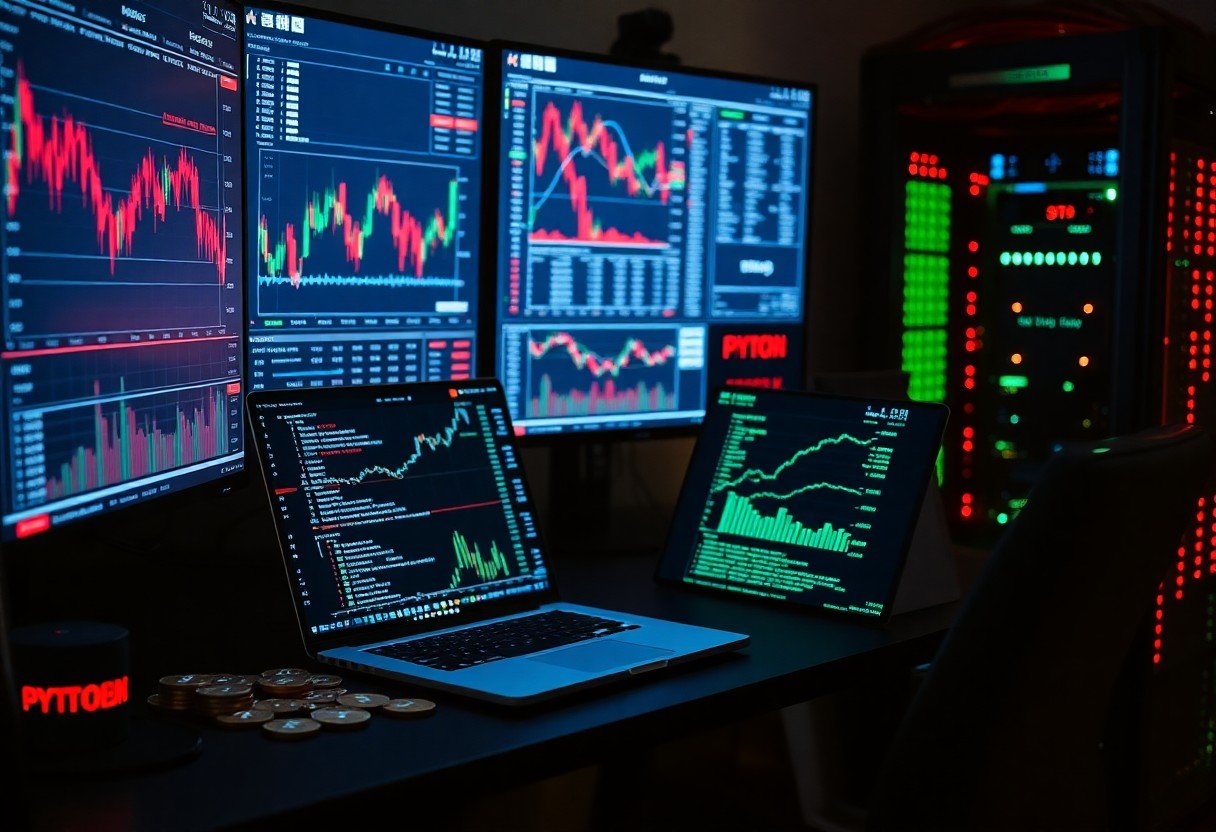
You see algorithmic trading reshape how prices form, liquidity flows, and risk propagates: high-frequency firms now account for roughly 50-60% of US equity volume and algorithmic activity often exceeds 50% on major crypto venues during active windows. As a result, market structure has moved toward microsecond execution, concentrated order-book liquidity, and faster cross-market arbitrage, which together compress spreads but also amplify systemic linkages that can transmit shocks across venues in seconds.
Liquidity and Volatility
Algorithms routinely provide passive quotes, narrowing spreads-on top BTC pairs you’ll often see spreads under $1-but they also withdraw instantly under stress, producing liquidity dry-ups that spike volatility. For example, during May 19, 2021 the intraday BTC move approached 30%, illustrating how liquidity providers can flip from stabilizers to amplifiers within milliseconds when adversarial conditions or adverse selection rise.
Market Efficiency
Arbitrage algorithms compress cross-exchange price differences so you usually find BTC quotes within 0.1% across major venues, and triangular arbitrage keeps multi-pair inconsistencies fleeting. You benefit from faster price discovery as basis trades between spot and perpetuals tighten, and latency-sensitive market makers force mispricings to evaporate in micro- to millisecond windows.
Digging deeper, funding-rate arbitrage is a concrete mechanism: when perpetual funding exceeds a few basis points per 8-hour period, your bots can execute long-spot/short-perp trades to capture the spread, typically restoring funding toward equilibrium. Institutional market makers colocate to shave milliseconds, while retail-driven slippage persists; the net effect is greater overall efficiency but also a dependence on ultra-fast counterparties that can leave slower participants exposed during rapid repricing.
Risks and Challenges
Systemic Risks
You’ve seen how a single algorithm can trigger market turmoil: Knight Capital lost $440 million in 45 minutes, and in crypto, automated strategies have caused billions of dollars in liquidations on extreme days. Flash crashes, exchange outages, and correlated margin calls create a single point of failure that propagates across venues, amplifying volatility and exposing your positions to rapid, systemic unwind.
Regulatory Concerns
You must navigate a patchwork of rules: the EU’s MiCA (2023) imposes licensing and reserve requirements for stablecoins, the US leans on case-by-case SEC enforcement, and China enforces a trading ban. That fragmentation enables regulatory arbitrage, forces costly compliance on your models, and raises the risk that a policy shift will make strategies noncompliant overnight.
Since FTX’s collapse in November 2022 and SEC actions against Binance and Coinbase in 2023, regulators demand stronger market surveillance; therefore your systems need real-time audit trails, stricter KYC/AML, and pre-trade risk controls. Decentralized venues and cross-border liquidity complicate enforcement, so your architecture must support granular reporting, geofencing, and rapid rollback capabilities to avoid fines or forced suspensions.
Comparing Traditional vs. Algorithmic Trading
| Traditional Trading | Algorithmic Trading |
|---|---|
|
Human-led execution, reliance on discretion and live decision-making; typically higher latency, limited scalability, and trading windows tied to exchanges. You face behavioral bias, manual order placement, and variable commission structures; institutional desks historically dominated price discovery. |
Automated strategies, backtested rules, and ultra-low latency execution measured in milliseconds or microseconds; enables 24/7 crypto markets, high-frequency participation (HFT ~50% of US equity volume historically), and consistent order routing, but introduces model risk and systemic amplification. |
Performance Metrics
You should evaluate algorithmic vs. traditional trading by execution speed, slippage, fill rate, and risk-adjusted returns like Sharpe and Sortino ratios; algorithms often reduce slippage by automating smart order routing, while human traders can sometimes extract informational edges in illiquid markets. Firms track milliseconds and basis points to quantify improvements.
- Latency: measured in ms/μs, directly impacts fill probability.
- Slippage: typically expressed in basis points; lower with optimized algos.
- Knowing risk-adjusted return changes is vital when comparing systems.
Psychological Factors
You experience emotional swings during drawdowns, leading to impulse trades or premature changes to strategy; algorithms remove moment-to-moment emotion but can magnify losses when model overfitting or unanticipated market regimes occur. Human oversight remains vital to stop automated cascades and to interpret contextual news events.
You must design guardrails: implement automatic stop-losses, position limits, and kill switches to curb reflexive human actions and unchecked algorithmic behavior. Many trading teams enforce 1-2% daily loss cutoffs and real-time monitoring dashboards so that when anomalies appear, you can intervene before losses compound.
- Emotional bias: drives inconsistent sizing and timing.
- Overfitting: leads to fragile strategies in live markets.
- Knowing operational controls-stop-losses, kill switches, limits-reduces both human and automated tail risk.

Future Trends in Crypto Trading
As algorithms ingest richer on-chain and off-chain signals, you’ll see trading shift toward continuous, adaptive strategies: transformer-based models and reinforcement learning agents will scan mempools, oracle feeds, and limit-book data in real time. Expect tighter spreads and faster rebalancing, alongside amplified exposure to MEV and smart-contract exploits. Integration across centralized venues and DEXs will favor firms that combine advanced execution with robust on-chain risk controls and regulatory-compliant transparency.
Evolution of Algorithms
Algorithms are moving from static rule-sets to self-learning systems that retrain on streaming tick and chain data; you’ll encounter reinforcement-learning market makers and transformer signal processors that adapt to regime shifts. Firms like GSR and Cumberland pair statistical arbitrage with ML-driven execution, creating sub-millisecond decision pipelines on CEXs while using simulated on-chain environments to test DeFi strategies and reduce slippage.
Integration with Decentralized Finance
DeFi composability lets your algos tap AMMs, lending pools, and oracle stacks to craft multi-leg strategies-arbitrage across Uniswap, Curve, and SushiSwap or leveraged positions via Aave-delivering 24/7 global liquidity and programmable execution. That access also amplifies risks from oracle manipulation, flash-loan exploit chains, and concentrated liquidity shifts, so your execution logic must account for MEV and on-chain settlement latency.
You can mitigate MEV and front-running by routing orders through private relays (Flashbots, MEV-Share) and employing on-chain TWAP/VWAP execution; Flashbots’ builder-executor separation (introduced around 2020) redirected much harmful frontrunning into more orderly extraction. Combining Chainlink or aggregated oracles reduces manipulation surface, but you still need hedges for bridge and oracle failure risk when deploying cross-chain, multi-protocol strategies.
Summing up
Following this, you can see that algorithmic crypto trading embodies a significant phase of market evolution, blending speed, data-driven strategies and automated risk controls to reshape liquidity and price discovery; however, you must weigh benefits against systemic risks, regulatory gaps and model fragility, and adapt your approach with rigorous testing, transparency and disciplined oversight to harness its potential responsibly.